
Let’s meet to discuss your IT project
Discover how modern technology can transform your business too. Get in touch with us, and together we’ll find a solution tailored to your needs.

Let’s meet to discuss your IT project
Discover how modern technology can transform your business too. Get in touch with us, and together we’ll find a solution tailored to your needs.
High-quality, systematically managed IT support is a key pillar of operational continuity for large organizations. Slow and fragmented incident handling without clearly defined escalation paths significantly increases both risk and downtime, threatening key business processes and slowing innovation.
Every minute of unplanned downtime causes financial losses, extends internal workflows, and overloads support teams — while damaging your reputation with customers, regulators, and partners. At the same time, operational costs grow and SLA penalties loom, as costly ad hoc interventions replace preventive measures.
ADF IT support is our comprehensive service that guarantees uninterrupted availability, accelerates incident resolution, and transforms IT support into a true strategic advantage.
Through short workshops, we understand your strategic goals, map both technological and process environments, and define measurable success metrics (availability, MTTR, OPEX).
The result is a clear baseline of performance and cost, complemented by a “risk registry” identifying major threats and quick wins.
We take over existing documentation, set up access (VPN, IAM, bastions), and become fully acquainted with your internal team and escalation processes.
Within 10 business days, we can take over operations without risk of losing know-how; this includes validation of operational documentation (runbooks) and a technical dry run.
We create a shared knowledge base in Confluence and unify ticket nomenclature so that all stakeholders “speak the same language.”
We deploy 24/7 monitoring and self-healing scripts (Zabbix, PRTG, Prometheus, Ansible, GitLab CI, Rundeck) for service restarts, autoscaling, and rollbacks.
Through correlation analysis and AI-driven alerting, we eliminate false positives and accelerate incident resolution (MTTR).
At the same time, we create an Automation Backlog to record and prioritize additional routine tasks suitable for full automation.
We generate monthly SLA and KPI reports, evaluate incident trends, and analyze cost drivers based on FinOps principles.
Dashboards provide real-time visibility into capacity usage, SLA fulfillment, and future cost forecasts.
Based on the data, we prepare quarterly optimization roadmaps and recommendations to reduce OPEX without compromising service quality.
Regular monthly review meetings verify SLA compliance, process quality, and two-way communication — always with the service owner present.
We use the CSI (Continual Service Improvement) methodology: for every major incident, we prepare an RCA and an action plan with clear deadlines.
Feedback from both business and IT is incorporated into the service catalog, ensuring support continuously reflects evolving priorities.
We go beyond maintenance: we manage change requests (CAB), technology upgrades, cloud migrations, and new solution designs.
For larger projects, we use Blue-Green or Canary deployments to minimize the risk of downtime.
Thanks to continuous collaboration on the roadmap, your infrastructure evolves seamlessly, supports new business models, and maintains a competitive edge.
Windows Server 2012–2022, RHEL / AIX, VMware
Azure, Kubernetes, Docker, Helm, OpenShift, Tanzu
Oracle, PostgreSQL, MSSQL, MySQL, MongoDB, Redis
Fortinet, Cisco, VPN, firewalls, IDS/IPS
PowerShell, Python, Bash, Ansible (AAP), AWX
Zabbix, PRTG, Splunk, ITM6, Netcool, Everbridge
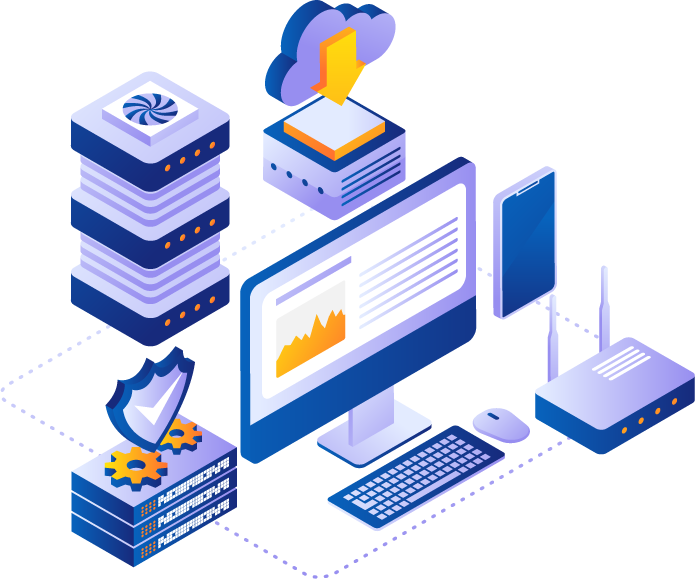
The most common entry point for users and operations teams. We provide a unified SPOC, ticket classification, and quick escalation (L1 → L3) in ServiceNow or Jira Service Management. Thanks to detailed runbooks and automated routing, MTTR shortens significantly, and reopen rates drop.
Continuous monitoring of servers, containers, and network components using Zabbix, PRTG, Prometheus, and Netcool. Log correlation in Splunk or Elastic and self-healing scripts in Ansible or PowerShell eliminate recurring incidents before they impact production.
Controlled updates for Windows Server, RHEL, VMware ESXi, and applications. We automate sandbox testing, monitor dependencies, and apply CIS Benchmarks — minimizing unplanned restarts and security risks.
Backups via Veeam or IBM Spectrum Protect with off-site replication to Azure Blob (immutability). Regular DR tests, RPO < 15 min, RTO < 2 h, and detailed runbooks in Confluence ensure verified and auditable business continuity.
Complete management of Azure / Microsoft 365 / SharePoint tenants — Entra ID, Exchange Online, Intune, IaC templates in Bicep / Terraform, and cost governance through Azure Monitor. Users enjoy a consistent experience across hybrid environments.
Continuous vulnerability scanning (Nessus, OpenVAS), centralized ESET / Bitdefender management, and event correlation in Splunk SIEM. Processes align with ISO 27001 and TISAX L3 standards, supporting quick audit readiness for both internal and external controls.
We manage change requests (CAB), rollouts via GitLab CI or Azure DevOps, and Blue-Green or Canary deployments. Integrated testing and approvals in the pipeline ensure zero-downtime releases with full traceability.
We inventory hardware and software using CMDB and MS SCCM / Intune. We eliminate unused licenses, unify versions, and give management a clear overview of TCO and planned renewals.
Analytics Data Factory s.r.o.
IČO: 046 20 852
DIČ: CZ046 20 852
Masarykovo náměstí 1544
530 02 Pardubice - Zelené Předměstí
Services by ADF
Data solutions
Cybersecurity
AI automation
IT support
IT contracting
Career
Copyright © 2021 Analytics Data Factory s.r.o.